Best Portable Power Stations
Losing power at the wrong moment costs more than comfort. A contractor whose tools go dead mid-job loses a day's labour. A retailer whose till system drops during a storm loses sales. A facilities manager whose critical monitoring equipment cuts out during a grid fault faces a much bigger problem than an inconvenience. This is the gap portable power stations were built to close: on-demand, mains-independent electricity that works the moment you need it, without a generator's fumes, fuel logistics, or noise.
Most buying guides for portable power stations talk about weekend camping trips and phone charging. That's a fair starting point, but it misses how these units are actually used across UK businesses and serious households: as backup power for critical infrastructure, as portable electricity for field engineers and site teams, as UPS-style protection for sensitive equipment, and as a genuinely dependable alternative to diesel generators on sites where noise or emissions are restricted.
This guide covers the full picture: how portable power stations work, what separates a genuinely capable unit from one that will disappoint you at the worst moment, and how to choose the right capacity and output for your specific use case, whether that's a single unit for occasional backup or a fleet of them for a multi-site operation.
What Is a Portable Power Station?
A portable power station is a self-contained rechargeable battery pack with built-in AC outlets, USB ports and DC outputs, paired with an inverter that converts stored battery energy into usable mains-equivalent power. Unlike a basic power bank, which only outputs low-voltage DC for phones and small electronics, a power station can run genuine UK three-pin appliances: laptops, monitors, power tools, small fridges, lighting rigs, medical devices and communications equipment.
You recharge it from a wall socket, a car's 12V socket, or a solar panel, and it then holds that charge until you need it, silently and without emissions. That combination of stored capacity, real AC output, and multiple recharge paths is what makes them useful in far more settings than camping: construction sites, warehouses, retail units, healthcare facilities, film and event production, telecoms cabinets, and home offices that can't afford downtime.
Why Businesses and Serious Users Choose Portable Power Stations Over Generators
Petrol and diesel generators still have a role, but they come with real drawbacks that portable power stations solve directly:
- No fumes or exhaust. Battery power stations can be used indoors, in enclosed spaces, or close to people and equipment, something no combustion generator can safely offer.
- Near-silent operation. Most units run well under 40dB, which matters on residential sites, in offices, at events, or anywhere noise restrictions apply.
- Zero fuel logistics. No storage, no spillage risk, no trips to a fuel station, and no fuel degrading in storage between uses.
- Instant, clean power. A pure sine wave inverter delivers the same stable waveform as the UK grid, which matters for sensitive electronics, medical devices, and audio-visual equipment that a modified sine wave source can damage or interfere with.
- Predictable maintenance. Lithium battery systems require none of the servicing, oil changes, or carburettor issues associated with small petrol engines.
The trade-off is that a portable power station's total energy is fixed at the point of purchase, unlike a generator that can run indefinitely with fuel. This is exactly why sizing correctly, covered below, matters more with battery power than with combustion power.
Key Features and Benefits to Understand
Battery capacity (Wh) tells you how much total energy the unit stores. This determines how long it can run your equipment before needing a recharge.
Output power (W) tells you how much load you can draw at any one time. A unit can have a large battery capacity but a limited output, meaning it can run small loads for a long time but cannot start high-draw equipment like compressors or heavy power tools.
Surge power is the short burst of extra power many motors and compressors need at start-up. A fridge or power tool can briefly demand two or three times its running wattage the moment it switches on, so checking surge rating against continuous rating matters when your equipment has a motor.
Battery chemistry varies between units. LiFePO4 (lithium iron phosphate) has become the standard for serious use because it is thermally stable, tolerates thousands of charge cycles before capacity drops meaningfully, and has a strong safety record. Older or budget lithium-ion (NMC) chemistry is lighter for the same capacity but degrades faster and carries a higher thermal risk profile, which is why most professional-grade units, including Schneider Electric's OffGrid range, have moved to LiFePO4 or equivalent stable chemistries.
Recharge paths matter for reliability. A unit that can recharge from a wall outlet, a vehicle socket, and solar panels gives you options when mains power isn't available, which is exactly the scenario these devices exist for.
Port selection determines what you can actually plug in. Look for genuine UK three-pin AC outlets with pure sine wave output, USB-C with Power Delivery for fast-charging modern laptops and phones, USB-A for older devices, and a DC car-style output for accessories.
Types of Portable Power Stations
Compact units (under 300Wh) are built for charging phones, small cameras, drones and laptops. They're light enough to carry easily but not intended to run appliances with a compressor or motor.
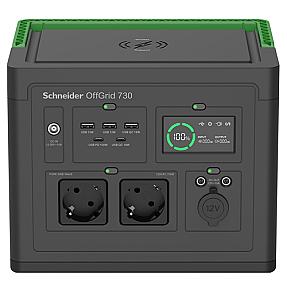
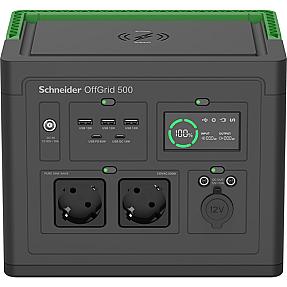
Mid-capacity units (300–800Wh) cover the largest share of practical use cases: powering laptops, lighting, communications gear, small medical devices, and short-duration tool use on site. This is where most of Pondesk's OffGrid range, including the 517Wh and 738Wh models, sits, offering enough stored energy for a working day of moderate use without the bulk of a larger system.
High-capacity units (1,000Wh and above) are aimed at running fridges, multiple devices simultaneously, or providing extended backup during longer outages. These are heavier and less portable but suit fixed backup applications such as server rooms, retail points of sale, or whole-site contingency power.
Industrial and multi-kilowatt systems move beyond what's typically considered "portable" and function closer to a battery-based generator replacement, intended for continuous site power or facility-level backup.
How to Choose the Right Portable Power Station
Start with a simple load calculation rather than the headline capacity number. List every device you need to run, note its wattage, and estimate how many hours you need it powered. Multiply the total wattage by the hours required, then divide by roughly 0.8 to account for inverter and conversion losses. That figure, in watt-hours, is your minimum required capacity.
Separately, check the highest continuous wattage of anything you'll run at once against the unit's continuous output rating, and check whether any of your equipment has a motor or compressor against its surge rating.
From there, weigh capacity against portability. A unit that comfortably covers your load but is too heavy to move between sites defeats the purpose of a "portable" power station. If the unit will be moved regularly between vans, sites or rooms, weight and carry handles matter as much as raw specification.
Finally, consider recharge speed. A unit that takes nine hours to refill by wall outlet is fine for overnight charging but a poor fit if you need it back in service within a few hours during the working day. If solar charging matters to your operation, confirm the unit's maximum solar input and expected recharge time under realistic UK light conditions, which will usually be longer than manufacturer figures based on peak sun.
Important Buying Considerations
Beyond capacity and output, a few factors are easy to overlook but affect real-world reliability:
- Warranty and support. A two-year warranty, as offered on Pondesk's Schneider Electric OffGrid units, gives meaningful protection against manufacturing defects and reflects confidence in build quality.
- Build materials and sustainability. Housings made from a high percentage of recycled plastic reduce environmental impact without compromising durability, a detail increasingly relevant for organisations with procurement sustainability targets.
- Operating temperature range. If the unit will be stored or used outdoors, check its rated storage and operating temperature range against the conditions it will face.
- Genuine stock and compliance. Counterfeit and grey-market power stations are a real risk in this category given the popularity of the leading brands. Sourcing from a verified supplier protects both the warranty and the safety of the unit.
- Volume and fleet purchasing. Businesses equipping multiple vans, sites or departments should look for suppliers who offer tiered pricing on bulk orders rather than paying single-unit retail rates repeatedly.
Common Use Cases
Portable power stations serve a wider range of scenarios than most guides acknowledge:
- Field engineers and technicians running laptops, diagnostic equipment and lighting away from mains power.
- Construction and trade teams powering hand tools, site lighting and communications equipment where a diesel generator isn't practical or permitted.
- Retail and hospitality protecting point-of-sale systems and essential lighting during unplanned outages.
- Healthcare and care settings providing backup for non-critical mobile equipment and communications during a mains interruption.
- Event and media production delivering clean, silent power for audio-visual equipment where generator noise or exhaust would be disruptive.
- Home and small office backup keeping routers, laptops and essential devices running through the UK's relatively infrequent but real power cuts.
- Outdoor and leisure use including camping, campervan trips and marine applications, where lightweight units with solar compatibility are especially valued.
Comparison: Matching Capacity to Task
| Scenario | Suggested capacity | Priority spec |
|---|---|---|
| Phone, laptop, small devices for a day | 250–350Wh | Portability, USB-C PD |
| Field engineer / tradesperson, moderate tools and lighting | 500–750Wh | Continuous output, surge rating |
| Small fridge, multiple devices, extended backup | 1,000Wh+ | Total output power, recharge speed |
| Fleet or multi-site deployment | Multiple mid-capacity units | Bulk pricing, consistent warranty terms |
Why Buy Portable Power Stations from Pondesk
Pondesk is a UK-based industrial technology platform built specifically for organisations that cannot afford uncertainty in what they purchase. Every portable power station listed is sourced through verified channels and supplied as genuine, fully compliant stock, which matters in a category where counterfeit and grey-market units are a documented risk.
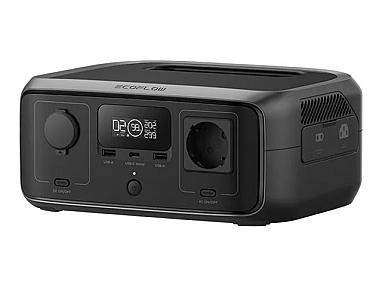
The range covers established, professionally specified units, including Schneider Electric's OffGrid Portable Power Stations with pure sine wave output, dual USB-C PD charging, sustainable recycled housing, and a two-year warranty, alongside consumer-proven options like the EcoFlow RIVER 3 for lighter, faster-charging needs. Because Pondesk works across regulated and mission-critical sectors, from industrial and energy through to healthcare and telecoms, the platform is built around the kind of procurement transparency and technical support that business buyers need but rarely get from consumer retailers.
For teams ordering more than one unit, whether equipping several vans or stocking multiple sites, Pondesk offers priority discounts from five units and exclusive volume pricing from twenty, with a straightforward quote process for resellers and larger orders. Support is available directly by email for anyone who needs guidance matching a unit's specification to their actual load before committing to a purchase.