Problem:
Every cell site needs a reliable routed connection back to the core network, along with accurate timing for TDD 5G to work properly. With proprietary cell site routers, operators are often tied to one vendor for both the hardware and routing software. This makes network upgrades more difficult because changing one can require replacing the other across thousands of sites.
Solution:
This solution provides temperature-hardened cell site routing on open hardware, allowing the network operating system and hardware to be purchased and upgraded separately. Built-in SyncE and IEEE 1588v2 provide accurate timing directly from the silicon, while grandmaster clocks can support multiple PTP profiles at the same time. This makes it easier to modernize the network gradually without replacing the entire cell site infrastructure at once.
Description:
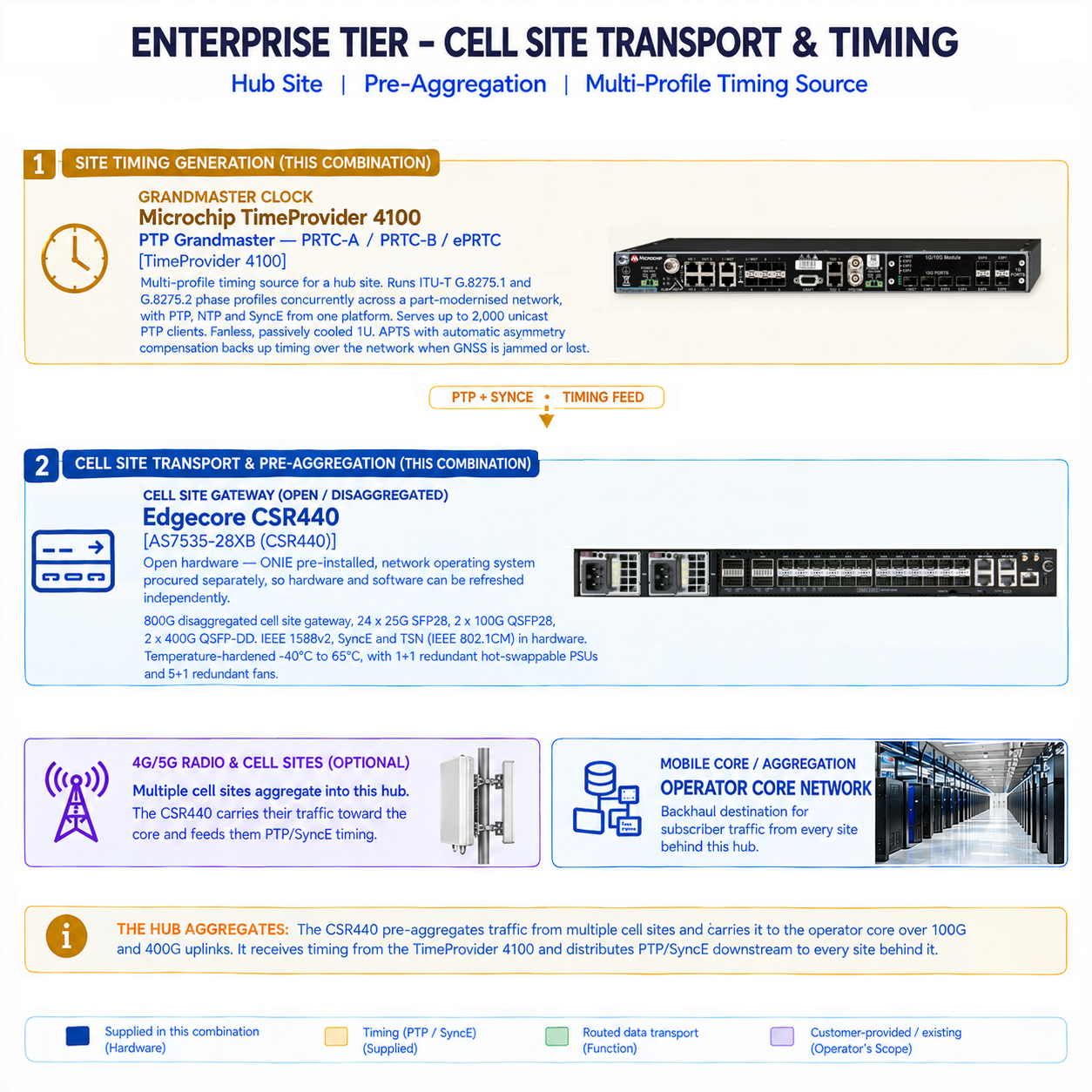
The Cell Site Transport & Timing Solution is built for mobile operators modernizing their cell sites who need two things at every location a routed path back to the core, and an accurate time reference without locking themselves to a single vendor for both the hardware and the routing software. At the hub site the problem changes scale: this location is not one cell site but the pre-aggregation points for many, and every site behind it depends on the transport and the timing that originate here. This Solution delivers that hub on open hardware with the network operating system procured separately, so the box and the software can be refreshed on independent cycles across the estate.
Built around the Edgecore CSR440 open cell site gateway, the Solution pre-aggregates the traffic of the sites beneath it and carries it to the operator core. Twenty-four 25G SFP28 ports, each also able to run at 1G or 10G, face the sites and the radios, while two 100G QSFP28 and two 400G QSFP-DD ports carry the aggregate upstream 800G of capacity in a single rack unit. Broadcom Qumran-2A silicon with a deep packet buffer and an Intel Xeon D-1539 eight-core processor handle the load, and IEEE 1588v2, SyncE and TSN (IEEE 802.1CM) are all implemented in hardware, so fronthaul-grade timing and bounded latency are properties of the silicon rather than of the software running on it. Pre-loaded with ONIE, the platform takes the operator's chosen NOS, and a temperature-hardened -40°C to 65°C design with 1+1 redundant hot-swappable power supplies and 5+1 redundant fan modules keeps a site that many others depend on from becoming a single point of failure.
Time is generated by a Microchip TimeProvider 4100 grandmaster. This is where the hub differs most sharply from a single cell site: the clock here is not serving one radio but every site downstream, so it is specified for scale and for survival. It serves up to 2,000 unicast PTP clients, meets PRTC Class A, Class B and enhanced PRTC (ePRTC) specifications, and runs the G.8275.1 and G.8275.2 phase profiles required by a part-modernized network where some paths carry full timing support and others only partial. Because a hub that loses GNSS takes every site behind it down with it, the platform is built to keep running without satellites: APTS with automatic asymmetry compensation recovers time over the network across up to 32 paths, a virtual PRTC architecture distributes precise time over the optical network rather than depending on local GNSS, and ePRTC operation holds accuracy for up to 40 days of holdover. Legacy E1/T1 output serves the parts of the network that have not yet moved, and two units can be paired active/standby for redundancy with switchover in under three seconds.
The reason both devices are needed is that they do different jobs: the grandmaster creates and protects time, and the gateway carries it and carries the data. Without accurate phase, adjacent TDD 5G cells transmit and receive at slightly different moments and interfere with each other at their boundaries and at a hub, that error propagates to every site fed from here rather than to one. The radios, the cell sites downstream and the mobile core remain the operator's, as does the network OS licensed onto the open gateway. The result is a vendor-neutral aggregation hub: open transport hardware refreshed independently of its software, and a timing source accurate enough, resilient enough and large enough to underwrite every site behind it.
Features
- Pre-aggregation at 800G 24 x 25G SFP28 facing the sites with 2 x 100G and 2 x 400G uplinks carrying the aggregate to the core
- Open cell site gateway ONIE pre-installed and the network OS procured separately, so hardware and routing software refresh on independent cycles
- Timing and determinism in silicon IEEE 1588v2, SyncE and TSN (IEEE 802.1CM) all implemented in hardware, not software emulation
- Timing at hub scale the grandmaster serves up to 2,000 unicast PTP clients across the sites behind it
- Beyond PRTC meets PRTC Class A, Class B and enhanced PRTC (ePRTC) specifications for the head of the timing chain
- Multi-profile grandmaster G.8275.1 and G.8275.2 phase profiles for a part-modernized network served from one source
- Survives GNSS loss APTS with automatic asymmetry compensation over 32 network paths, virtual PRTC distribution, and up to 40 days of ePRTC holdover
- Serves what hasn't moved yet legacy E1/T1 output alongside PTP, NTP and SyncE from the same platform
- No single point of failure 1+1 redundant hot-swappable PSUs and 5+1 redundant fans on the gateway; active/standby grandmaster pairing with sub-three-second switchover
- Clean layer separation Solution supplies the gateway and grandmaster; radios, downstream sites, mobile core and NOS remain the operator's
Specifications
|
Component
|
Model / Detail
|
|
Cell Site Gateway
|
Edgecore CSR440 open disaggregated cell site gateway 800G
|
|
Gateway Interfaces
|
24 x 25G SFP28 (1G/10G/25G), 2 x 100G QSFP28, 2 x 400G QSFP-DD
|
|
Gateway Platform
|
Broadcom Qumran-2A silicon, Intel Xeon D-1539 8-core
|
|
Grandmaster Clock
|
Microchip TimeProvider 4100 PRTC-A, PRTC-B and ePRTC
|
|
Timing Capacity
|
Up to 2,000 unicast PTP clients
|
|
Phase / Time Sync
|
IEEE 1588v2 PTP, G.8275.1 and G.8275.2 profiles
|
|
Frequency Sync
|
Synchronous Ethernet (SyncE), with NTP and legacy E1/T1 output
|
|
GNSS Resilience
|
APTS with automatic asymmetry compensation, virtual PRTC, ePRTC holdover
|
|
Determinism
|
TSN (IEEE 802.1CM) in hardware on the gateway
|
|
Network OS
|
Procured / licensed separately (ONIE pre-installed, open hardware)
|
|
Redundancy
|
Gateway 1+1 PSUs and 5+1 fans; grandmaster active/standby pairing
|
|
Environment
|
Gateway temperature-hardened -40°C to 65°C; grandmaster fanless 1U for hub facilities
|
Ideal For
Hub sites and pre-aggregation points terminating the transport and timing of many cell sites, operators whose timing architecture must survive GNSS jamming, spoofing or outage without taking an entire region down, part-modernized networks that must serve multiple PTP profiles and legacy E1/T1 from a single source, fronthaul deployments requiring TSN and bounded latency in hardware, sites needing 25G to the access layer with 100G and 400G to the core in one rack unit, operators moving away from proprietary aggregation routers toward open hardware with a separately-licensed NOS, and any operator seeking to refresh transport hardware and routing software on independent cycles rather than being tied to a single vendor for both.