Problem:
Access traffic needs to be brought together and transported across the metro network, but traditional approaches can add cost and complexity. Proprietary aggregation platforms tie the routing software to specific hardware, making upgrades less flexible. Using a separate optical transport layer also means adding more equipment, power consumption, and extra interfaces for each link leaving the site.
Solution:
This solution provides high-density 100G and 400G aggregation on open hardware, with the network operating system licensed separately. Coherent optics can be connected directly to the router, allowing the separate transport layer to be removed where needed. For deployments that require more flexibility in router ports or client rates, standalone transponders can still be used.
Description:
The Metro Aggregation & Optical Transport Solution is built for operators who need to concentrate access traffic and carry it across the metro, without paying the two costs that conventional designs impose. Proprietary aggregation platforms lock the routing software to the chassis, and a separate optical transport layer adds equipment, power and a second set of interfaces for every link that leaves the site. This Solution answers both: high-density 10G and 25G aggregation on open hardware with the network operating system licensed separately, and a choice of how traffic leaves the site a coherent optic plugged straight into the router, or a standalone transponder where flexibility matters more.
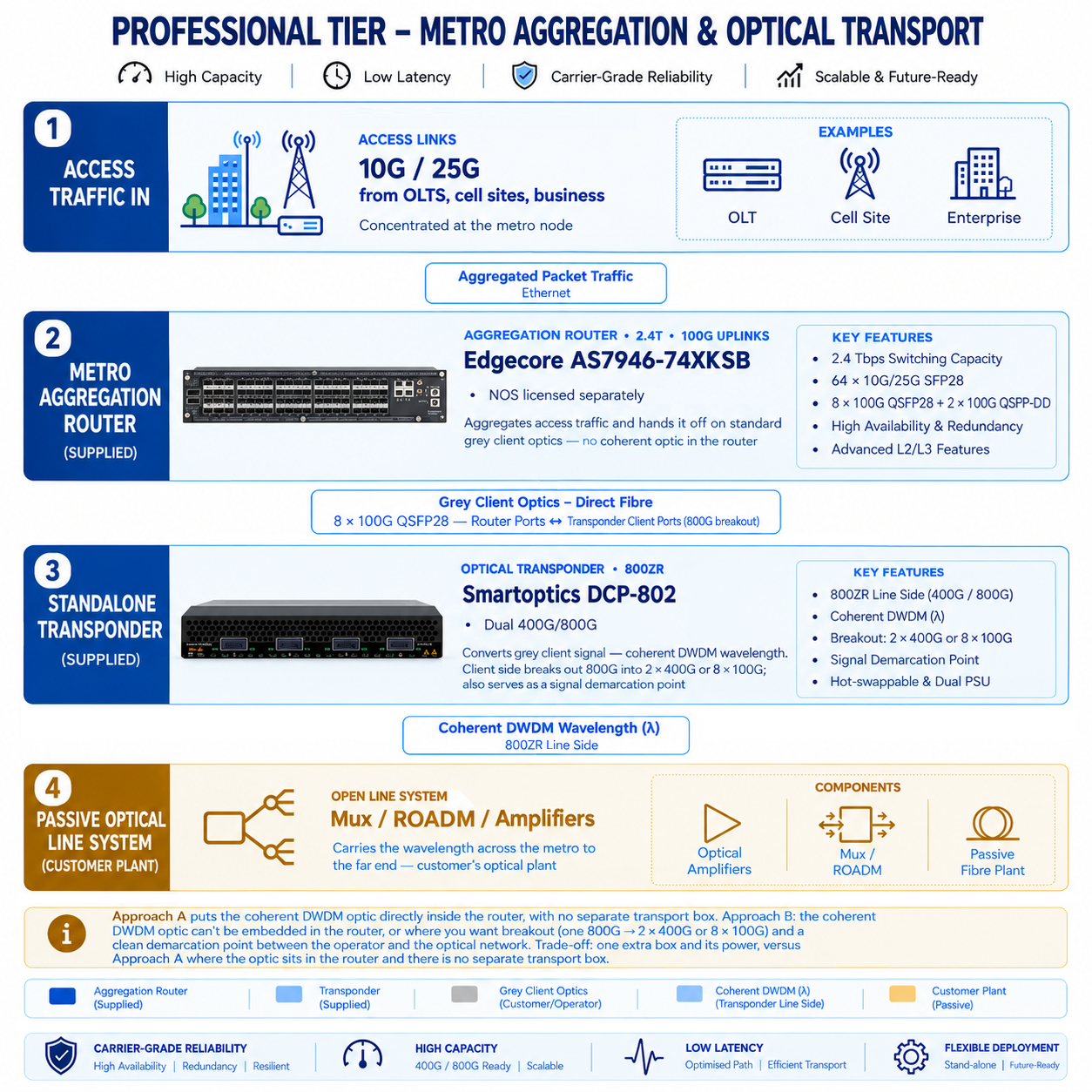
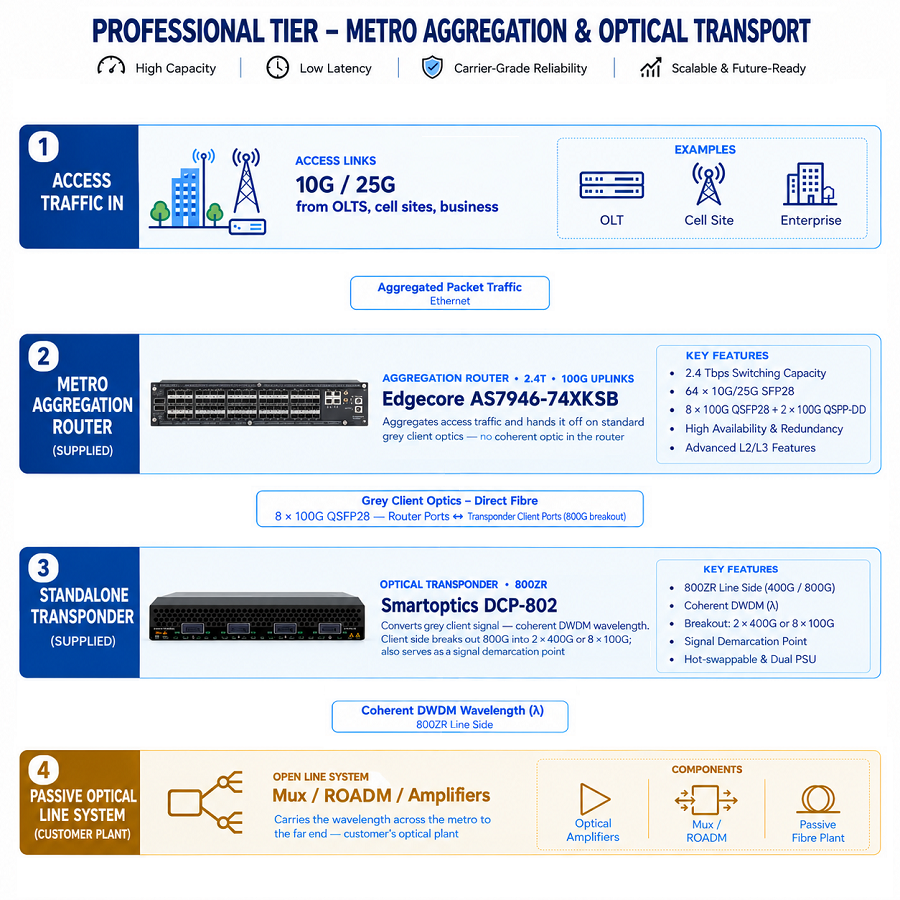
Driven by an Edgecore AS7946-74XKSB aggregation router, the Solution concentrates mixed 10G and 25G access onto 100G uplinks across a 2.4 Tbps platform. Sixty-four SFP28 ports face the access layer at 10G or 25G, eight 100G QSFP28 ports carry the aggregate upstream, and two high-power 100G QSFP-DD ports provide the option of a coherent optic in the router itself. Broadcom Qumran-2C silicon with an external BCM16K lookup engine handles large rule databases at line rate in a 2RU chassis. Because it is open hardware, the routing software is licensed separately rather than welded to the box, so the chassis and the NOS are refreshed on independent cycles. This breaks the proprietary tie that makes traditional aggregation platforms expensive to own over time, and it is the same open-hardware principle that runs through the rest of this catalogue.
How traffic leaves the site is the Solution's central choice. In the transponder-free approach, a coherent pluggable goes into one of the router's high-power QSFP-DD ports and the router lights its own DWDM wavelength the transport layer disappears entirely, and with it a whole box, its power and its interfaces. That approach is bounded by the port: this platform is a 100G-uplink router, so the wavelength it lights itself is a 100G coherent one. Where a higher line rate is needed, or where a coherent optic cannot be embedded at all, a Smartoptics DCP-802 standalone transponder is connected directly to the router by a fiber patch. The router hands off on standard grey client optics, and the transponder converts them to a coherent DWDM wavelength at 400G or 800G well beyond what the router could light on its own.
The transponder also changes the economics of the fiber. Its client side accepts eight 100G links and combines them into a single 800G coherent wavelength, so eight of the router's 100G ports leave the site on one wavelength instead of eight. The same unit provides a clean demarcation point with integrated performance monitoring, giving a defined hand-off between the operator and the optical network and a place to verify the signal before it leaves. Either way, the wavelength is carried across the metro by a passive optical line system mux, ROADM and amplifiers which, along with the access traffic, remains the operator's existing plant. The Solution supplies the active aggregation router and, where the transponder approach is used, the transponder; the network OS is licensed separately and the optical line plant stays in place. The result is a metro edge the operator actually owns: open aggregation hardware refreshed independently of its software, and the freedom to collapse the transport layer into the router or keep it as a separate, flexible box site by site, without redesigning the node.
Features
- Open aggregation hardware NOS licensed separately, so the chassis and routing software refresh on independent cycles
- High-density aggregation sixty-four 10G/25G access ports concentrated onto eight 100G uplinks on a 2.4T platform
- Two ways off the site a coherent optic in the router (no transport box) or a standalone transponder, chosen per site
- Transponder-free option a coherent pluggable in a high-power QSFP-DD port lets the router light its own 100G wavelength and removes the transport layer
- Standalone transponder option DCP-802 connects directly to the router where a higher line rate, breakout or demarcation matter
- Eight ports onto one wavelength the transponder combines 8 × 100G client links into a single 800G coherent wavelength
- Breakout flexibility the same unit splits one 800G into 2×400G or 8×100G client services as the site requires
- Clean demarcation the transponder gives a defined hand-off point with integrated performance monitoring
- No vendor lock-in open hardware breaks the proprietary tie between aggregation chassis and routing stack
- Clean layer separation Solution supplies the router (and transponder when used); NOS, access traffic and optical line plant remain the customer's
Specifications
|
Component
|
Model / Detail
|
|
Aggregation Router
|
Edgecore AS7946-74XKSB 2.4T switching capacity
|
|
Access Interfaces
|
64 × 10G/25G SFP28
|
|
Uplink Interfaces
|
8 × 100G QSFP28 and 2 × 100G QSFP-DD (high-power optics)
|
|
Silicon
|
Broadcom Qumran-2C with external BCM16K lookup engine, 2RU
|
|
Optical Transponder (Approach B)
|
Smartoptics DCP-802 dual 400G/800G, 800ZR [DCP-802]
|
|
Approach A IPoDWDM
|
Coherent pluggable in a high-power QSFP-DD router port, lighting a 100G wavelength
|
|
Approach B Standalone
|
Router hands off grey client optics → transponder → 400G/800G DWDM wavelength
|
|
Router-to-Transponder
|
Direct fiber patch, 8 × 100G grey client optics into one 800G wavelength
|
|
Line Side
|
Coherent DWDM wavelength (800ZR)
|
|
Network OS
|
Licensed / procured separately (open hardware)
|
Ideal For
Operators concentrating mixed 10G and 25G metro access traffic who want to own their aggregation edge rather than rent it from a proprietary vendor, networks moving to open hardware with a separately-licensed NOS, sites that can collapse the transport layer by embedding a coherent optic directly in the router, sites that instead need a transponder to reach 400G or 800G on the line, nodes where several 100G services should share one wavelength rather than one fibre each, deployments wanting a clean optical demarcation point, and any operator wanting the freedom to choose site by site between a transponder-free router and a router-plus-transponder design without redesigning the metro node.