The Core of High-Performance Workstations
In the world of high-performance computing, your motherboard isn’t just a component—it’s the foundation of your entire workstation. For professionals working in content creation, 3D rendering, AI development, or complex simulations, the Extended ATX (E-ATX) motherboard is a game-changer. With larger dimensions, more expansion slots, and superior power delivery, E-ATX motherboards give you the flexibility, stability, and performance you need to tackle the most demanding workloads.
Unlike standard ATX boards, E-ATX motherboards are designed to handle multiple GPUs, high-core-count CPUs, large memory capacities, and fast storage simultaneously. This makes them ideal for engineers, designers, data scientists, and power users who require robust performance without compromise. Whether you’re building a workstation for video editing, AI training, or virtualization, choosing the right E-ATX motherboard ensures that your system can grow and adapt as your professional needs evolve.
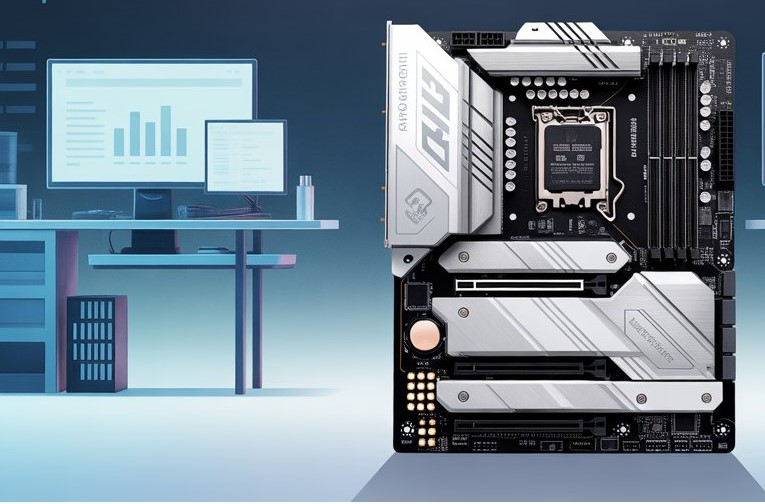
Why E-ATX Motherboards Are Essential for Professionals
E-ATX motherboards are engineered to support high-end components and demanding workloads. Here's why they are the preferred choice for professionals:
-
Enhanced Connectivity: E-ATX boards typically feature multiple PCIe slots, enabling the installation of multiple GPUs and expansion cards, which is crucial for tasks like 3D rendering and scientific simulations.
-
Superior Power Delivery: With advanced VRM (Voltage Regulator Module) designs, E-ATX motherboards ensure stable power supply to the CPU and other components, facilitating overclocking and handling power-hungry applications.
-
Ample Memory Support: These motherboards support large amounts of high-speed memory, which is vital for applications that require substantial RAM, such as video editing and virtual machines.
-
Comprehensive I/O Options: E-ATX boards come equipped with a variety of ports and slots, including USB 3.2, Thunderbolt, and multiple M.2 slots, ensuring fast data transfer and connectivity.
Pondesk Recommended E-ATX Motherboards
Pro WS WRX80E-SAGE SE WiFi Extended ATX Workstation Motherboard
The Pro WS WRX80E-SAGE SE WiFi is a top-tier choice for professionals who demand stability and uncompromising performance. Engineered for AMD Threadripper PRO processors, this board supports heavy multitasking, virtualization, and workstation-level workloads with ease. Its robust design ensures consistent reliability for creators, engineers, and researchers.
Key Points:
-
AMD Threadripper PRO CPU support
-
8-channel DDR4 memory with ECC support
-
Multiple PCIe 4.0 slots for advanced GPU setups
Dual 10Gb LAN & WiFi 6E for ultra-fast networking.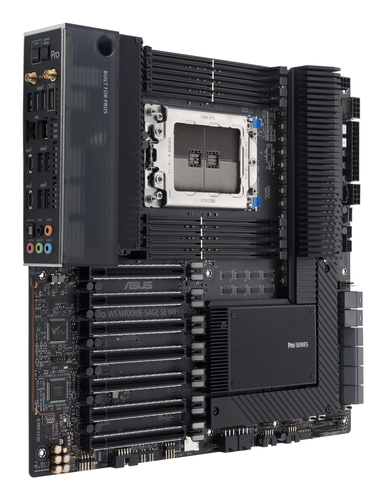
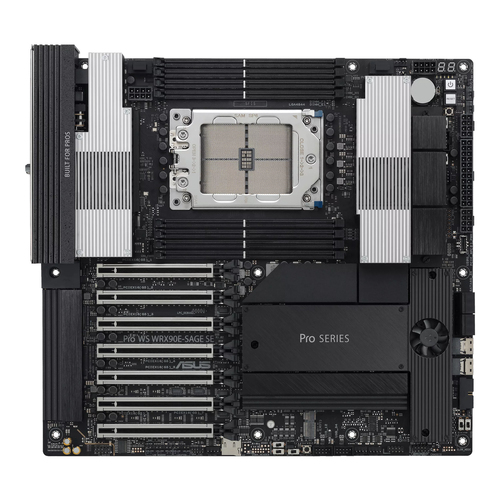
ASUS Pro WS WRX90E-SAGE SE Motherboard
The ASUS Pro WS WRX90E-SAGE SE takes workstation motherboards to the next level. Built with server-grade reliability and cutting-edge technology, it’s ideal for AI, VFX, 3D rendering, and enterprise data analysis. This EEB-sized powerhouse brings together expansion flexibility and advanced cooling for non-stop operations.
Key Points:
-
Optimized for AMD WRX90E platform
-
Enterprise-class stability & server-grade features
-
PCIe 5.0 support for GPUs & accelerators
-
Perfect for multi-GPU rendering and AI workloads
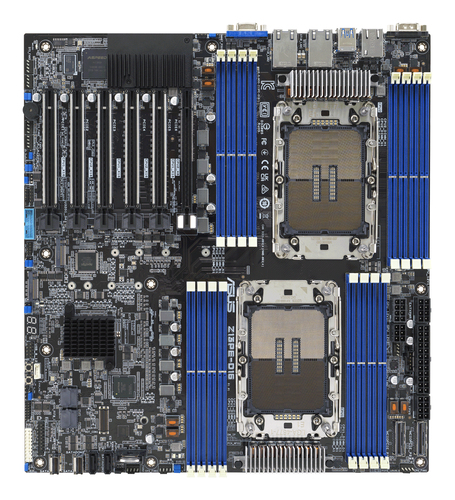
ASUS Z13PE-D16ASMB11 Intel LGA 4677 Socket E-ATX Server Motherboard
For those who work with large datasets, virtualization, or engineering simulations, the ASUS Z13PE-D16ASMB11 is the answer. Supporting Intel Xeon processors and DDR5 memory up to 2TB, it’s designed for extreme workloads and uninterrupted uptime. Its advanced thermal management makes it a top choice for enterprise data centers.
Key Points:
-
Intel Xeon scalable processor support
-
Up to 2TB DDR5 ECC memory capacity
-
Multiple M.2 & U.2 slots for high-speed storage
-
Durable design for continuous professional use.
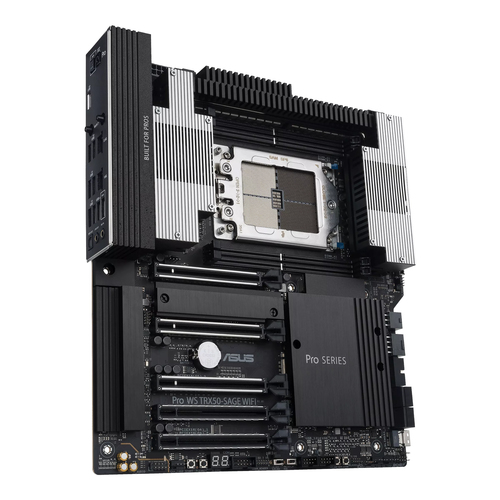
ASUS Pro WS TRX50 SAGE WiFi Threadripper 1000 Series E-ATX
Designed for AMD Threadripper CPUs, the Pro WS TRX50 SAGE WiFi delivers workstation-class computing power for creative professionals. With multiple PCIe slots and optimized GPU support, it’s perfect for video editing, 3D modeling, and rendering pipelines. Its enhanced connectivity ensures smooth collaboration across platforms.
Key Points:
-
AMD TRX50 platform compatibility
-
Multiple GPU-ready PCIe slots
-
WiFi 6 + high-speed LAN for seamless networking
-
Tailored for content creators & 3D professionals
GIGABYTE W790 AI TOP Intel Xeon W Processor Motherboard
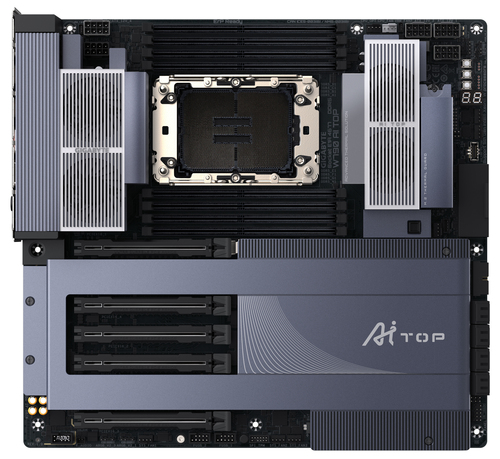
The GIGABYTE W790 AI TOP is a premium workstation motherboard built to accelerate AI development, deep learning, and data analytics. Featuring PCIe 5.0, DDR5 support, and Thunderbolt 4, it ensures seamless high-speed data handling. Its enterprise-grade design is ideal for researchers and enterprises who demand uncompromising performance.
Key Points:
-
Intel Xeon W processor support
-
6x M.2 slots with PCIe 5.0 for storage flexibility
-
WiFi 7 & 10GbE LAN for future-ready networking
-
Perfect for AI, simulation, and enterprise computing
GIGABYTE Z790 AORUS MASTER LGA1700 EATX Motherboard
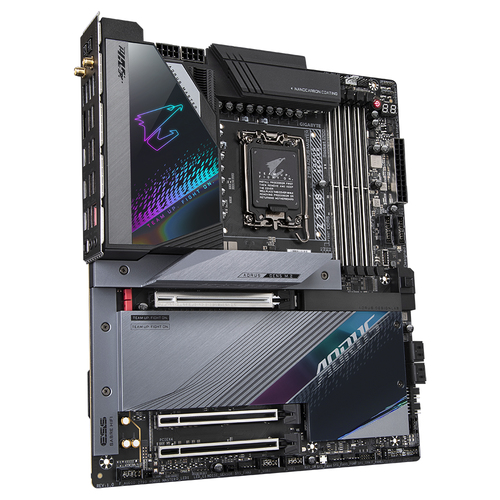
The Z790 AORUS MASTER is designed for professionals and enthusiasts who want raw power with advanced overclocking potential. Supporting Intel 12th/13th Gen processors, DDR5 memory, and PCIe 5.0, it delivers ultimate speed and responsiveness. Whether for gaming, content creation, or heavy workloads, it’s a versatile E-ATX solution.
Key Points:
-
Intel 12th/13th Gen CPU support
-
DDR5 memory with extreme frequency support
-
PCIe 5.0 + advanced cooling for stable performance
-
Ideal for enthusiasts, gamers, and creators
FINAL WORD
E-ATX motherboards form the backbone of serious workstations, offering unmatched expandability, power, and scalability for professionals who demand more. Whether your work is creative, scientific, or technical, choosing the right E-ATX board ensures you can grow, scale, and perform without limits.
Explore more E-ATX motherboard options right now:
Extended ATX Motherboards on Pondesk
FAQs About E-ATX Motherboards
Q1: Are E-ATX motherboards just for extreme builds?
Not always. While they excel in high-performance systems, they also offer headroom—you can start with a simpler build and expand later.
Q2: Will an E-ATX board fit in standard full-tower cases?
Many full-tower and large mid-tower cases support E-ATX. Always check case specs—some smaller towers won’t.
Q3: Do I need an advanced PSU (power supply)?
Yes—because E-ATX systems often run multiple GPUs, numerous drives, powerful CPUs. A high-quality, high-wattage PSU with good rails is essential.
Q4: Is there a noticeable performance jump over ATX boards?
If your workload uses multiple expansion cards, heavy I/O, or large memory and GPU setups, yes—you’ll see better stability, performance scaling, and capability. For average workloads, the difference might be smaller.
Q5: Are E-ATX motherboards more expensive?
Yes, typically due to more layers, higher-spec components, and expanded features. But for professional use, the investment pays off in capability and longevity.
Comments (0)